


Why are the French revolting?
If you are a Mel Brooks fan, you may recognize in that question the famous joke from that glorious collection of historical mythologies known as History of the World, Part I (1981).
In that scene, set at Versailles before the French Revolution, the Count of Money (Harvey Korman) reports to King Louis XVI (Mel Brooks) that “the people are revolting!”
The king responds, “You said it. They stink on ice!”
The joke and other common misconceptions about the French Revolution are relevant to the ways that media, politicians, and other observers are assessing the current riots in France.
There have been many explanations for the protests and looting that have rocked France, Italy, Albania, and elsewhere. The American mainstream media originally stuck close to the initial rationale for the protests, citing unfunded schools and angry students. As the riots became more destructive and were joined by hundreds of thousands of non-student protestors, media reports included income inequality and other issues of “affordability” in the rationale. That, of course, fits nicely with the midterm messaging of the Democratic Party in the U.S.

Others, like Vice President J. D. Vance, have pointed to unfettered migration into Europe which have brought the problems of the “Global South” into those countries. The Palestinian flags, keffiyehs, and spray paint graffiti on monuments and shops proclaiming “Free Gaza” suggest that the aims of many protestors extend beyond their local economies. People upset over affordability do not have an obvious reason to dress a statue of St. Joan of Arc in a hijab and adorn it with a Palestinian flag, as happened on October 17 in Toulouse.
The debate over the motivations of the protestors will continue, if only because media outlets are unlikely to ask the protestors themselves. But from the vantage point of history, which is my beat, it is clear what the protests are not about.
Congressman Ro Khanna, who seems interested in one day becoming president, tweeted on October 19:
From the high schools of France to the Streets of Madrid to the universities of Tirana, young people are telling their governments the same thing: in an age of massive wealth inequality, they want a future they can believe in…. The [sic] is what happens when nations let wealth and power accumulate in the hands of a few.
So, like the peasants used as target practice by Mel Brooks’s Louis XVI, the people of Europe are fed up with gross inequalities that allow a few ultrawealthy to live like kings, while everyone else struggles in squalor. No wonder many of the protestors bore signs that read, “Tax the Rich.” The poor in these protests are destroying the symbols of their oppressors and demanding, in Rep. Khanna’s words, “an economic and political transformation.”
This sounds good, but it is wrong.
Whatever is leading Europeans to burn their cities, it is not wealth inequality. By every modern measurement, the erupting European countries have the least inequality in wealth and income in the entire world.
The Gini Coefficient measures wealth or income disparities across all countries, producing an index range between 0 (perfect equality) and 100 (one person has everything). According to the World Population Review, the lowest Gini index in the world is 23.8 in Slovakia. In other words, Slovakia is where income inequality is the lowest.
What about France, where Rep. Khanna tells us there is “massive wealth inequality”?
France is among the most equal countries in the world in terms of income, with a Gini index of 31.8. The other protesting countries? Italy is at 34.3, Spain 33.4, Albania 29.4, and Belgium has a miniscule 26.8. By comparison, the United States has a Gini index of 41.8.
Who are the worst offenders when it comes to wealth inequality? South Africa wins with 63.0, followed distantly by Namibia at 59.1, then rounding out those above 53, come Botswana (54.9), Eswatini (54.6), and Columbia (53.9). In fact, the Vice President’s “Global South” is not just overrepresented among countries with extreme wealth inequalities, it is their only home. No country north of the equator has a Gini index higher than 45.
Why then are the countries with the most wealth equality experiencing violent protests, while those with the most inequality remain silent? Because in history “massive wealth inequality” is rarely, if ever the cause of an uprising.
That may seem counterintuitive. It is a commonplace to say that a society becomes unstable when “the rich get richer and the poor get poorer.” After all, look at what happened during the French Revolution. The monarchy was enjoying lavish banquets at Versailles while the French commoners were starving on the streets of Paris. Marie Antoinette sniffed at their poverty, proclaiming, “Let them eat cake!” Finally, the poor could take it no longer. They rose up, stormed the Bastille, executed the king, and formed a republic of the people.
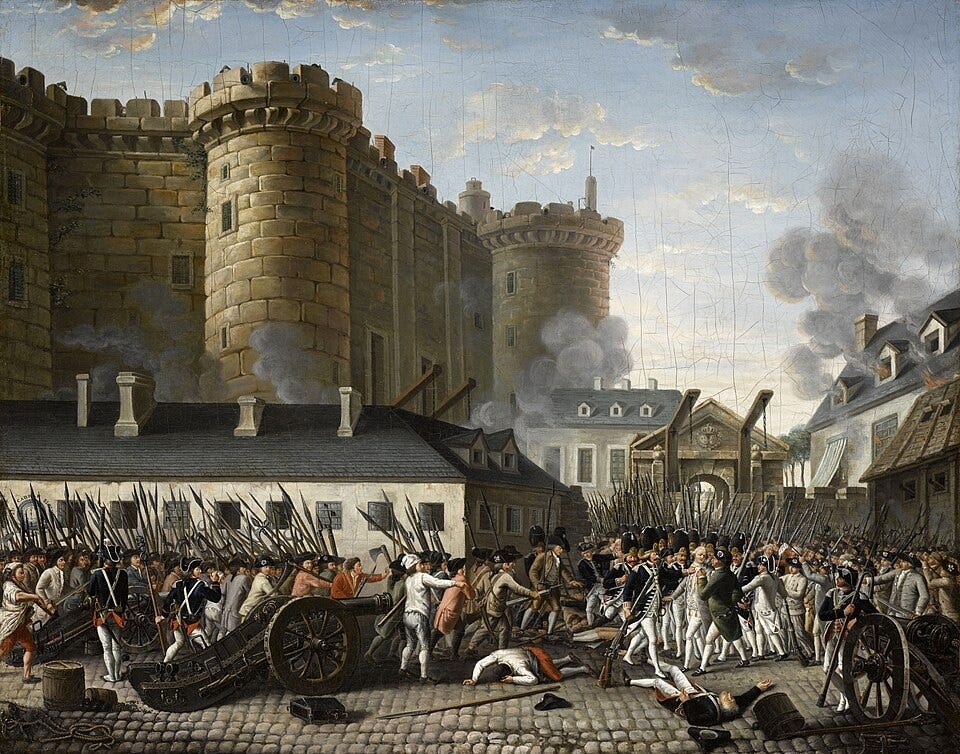
But, pace Mel Brooks, that is not what happened in the run up to the French Revolution. In the 1780s the French monarchy was not becoming richer. Indeed, the royal government was heavily in debt. Meanwhile, the poor in France had more wealth than ever before, owing to a vibrant economy fed by new technologies and overseas trade. The French Revolution occurred because the rich were becoming poorer and the poor were becoming richer. The rise of the middle class, made up of businessmen and skilled laborers, created a new affluent constituency that was cut out of political power by the nobility and clergy. As far as economics go, that is what led to revolution.
If you think about it, this all makes sense. Truly poor people, the kind that have existed throughout human history and across the world, have neither the time nor the inclination to revolt against the rich. Their focus is exclusively on survival. Unlike eighteenth-century Parisian poor, medieval serfs did not have taverns, coffee houses, or salons where they could exchange books about the rights of man. The focus of most pre-industrial poor was on the protection of their family and finding their next meal. They feared starvation, not political disenfranchisement. As a historical dynamic, massive wealth inequality does not cause rebellions, it suppresses them. The Peasant Revolts in Europe happened after the Black Death, when wages rose and agricultural laborers had full bellies. They had the luxury of being angry.
Economic historians like Branko Milanovic have run the numbers. During the Middle Ages Gini indices in Europe ranged from the 60s to the 80s.1 There are no countries today with such drastic wealth inequalities as medieval Europe.
In the eighteenth century, on the eve of the French Revolution, the Gini index in France probably stood at around 55 – about the same as modern Botswana, but not as bad as Namibia or South Africa.2 One study suggests that it may even have been as low as 37.3 In other words, wealth inequality in France in 1789 had never been lower. But the medieval political system had not adapted to that change. That is what led to revolution.
The riots in France are likely to continue, if only because they are a useful tool in the upcoming elections. But they have nothing to do with wealth inequality. With France’s tax bill approaching 50% of GDP and exploding deficits, the French government has created an economy that levels incomes in favor of a welfare state. The protestors, though, will always want more.
As Mel Brooks’s Louis XVI complained, they keep “drifting to the left.”
Thomas F. Madden is Professor of History at Saint Louis University. His most recent book is The Fall of Republics: A History from Ancient Carthage to the American Constitution (Princeton).
See, for example, Branko Milanovic, Peter H. Lindert, Jeffrey G. Williamson, “Pre-Industrial Inequality,” The Economic Journal 121 (2011): 25572.
Christian Morrisson and Wayne Snyder, “The Income Inequality of France in Historical Perspective,” European Review of Economic History 3 (2000): 59-83.
Branko Milanovic, “The Level and Distribution of Income in Mid-Eighteenth-Century France, According to Francois Quesnay,” Journal of the History of Economic Thought 37 (2015): 17-37.
Interesting article.
If I understand you correctly, Professor, revolutions DO NOT begin because of severe wealth inequality, but rather because the rich get poorer and the poor get richer. Revolution, therefore, is sparked by an ascendant middle class, is that right? I can see how this applies, and don't need to look further than the American Revolution.
While I value the merit of the metrics, I don't think they have as much applicability as one might assume. Numbers, however much they might reflect actual reality, do not make the people experiencing reality any more content. That is to say, with the toxic noise machine that is media--both social and legacy--disparity and divide are amplified beyond all bounds. This is now the milieu in which we swim, and is, beyond any historical precedent, the lived experience of people, regardless of what the numbers bear out.
That’s it exactly.