


In the James Bond movie Casino Royale (2006) the exciting climax takes place in a Venetian palazzo on the Grand Canal.
Like all of Venice in this movie, the palazzo floats on enormous air tanks. When gunfire ruptures the tanks, the entire building drops beneath the waves without a trace.
Never mind that the Grand Canal is only sixteen feet deep and the palaces that face it are built on good, solid earth. In the modern mind (or at least in Hollywood’s mind), the exquisite city has become so fragile that a well-aimed bullet can sink its most magnificent structures. It has become an endangered species, something that can only survive by means of an international effort to restore its natural habitat. No wonder, then, that one of the founders of the Venice in Peril Fund suggested that the venerable organization be disbanded, since “Venice is going to be underwater in a hundred years anyway.”
So what is killing Venice? Well, a great many things if you believe the warnings.
Floods of Water
First, there is the water. If you build your city in the middle of a lagoon, you have to expect to get wet. But Venice is getting wetter than ever before.

Its greatest floods may have been in the Middle Ages, yet the frequency of small floods, known as acqua alta, have been rising steadily since the 1960s. Today the lowest portions of the city (including the famous Piazza San Marco) flood dozens of times a year. On average, one-seventh of the city floods four times annually.
It is true that Venice is sinking, but no more today than New York or most other coastal cities. However, Venice’s natural elevation was artificially lowered by years of pumping ground water out of its aquifer to support the nearby Porto Marghera industrial zone.
And then there is the modern tinkering with Venice’s canals, dredging some for massive tankers and filling others to expand pedestrian traffic. These modifications restrict the lagoon’s ability to handle variable water levels. As a result, when strong winds blow high tides into Venice’s lagoon the water simply has nowhere to go. It flows uninvited into the streets, churches, and houses. The Italian government deployed the long-delayed MOSE project to close off the lagoon during high tides, but there remain bitter disagreements over its long-term effects.
Floods of Tourists
Others worry that Venice is drowning under a different sort of deluge -- unrestrained tourism. During the 1970s and 1980s the arrival of budget travelers (many clutching their copies of Let’s Go!) led to a steady increase in the numbers of tourists, although not a corresponding increase in tourist revenue. Student travelers tended to crash in low-cost pensione in Padua or Mestre and took the train to Venice to see the sights. They crowded the railroad stations, the streets between Rialto and San Marco, and the “No. 1” vaporetto route running the length of the Grand Canal. They poured into the Piazza San Marco, crowded onto the Molo to have their pictures taken, and left behind tons of sandwich wrappers and paper bags. During the 1970s the Venetians passed a number of laws to prohibit sleeping in the campi and train station, or even sitting on the ground in the Piazza San Marco. Nothing stemmed the tide of the camera-clutching day-trippers.
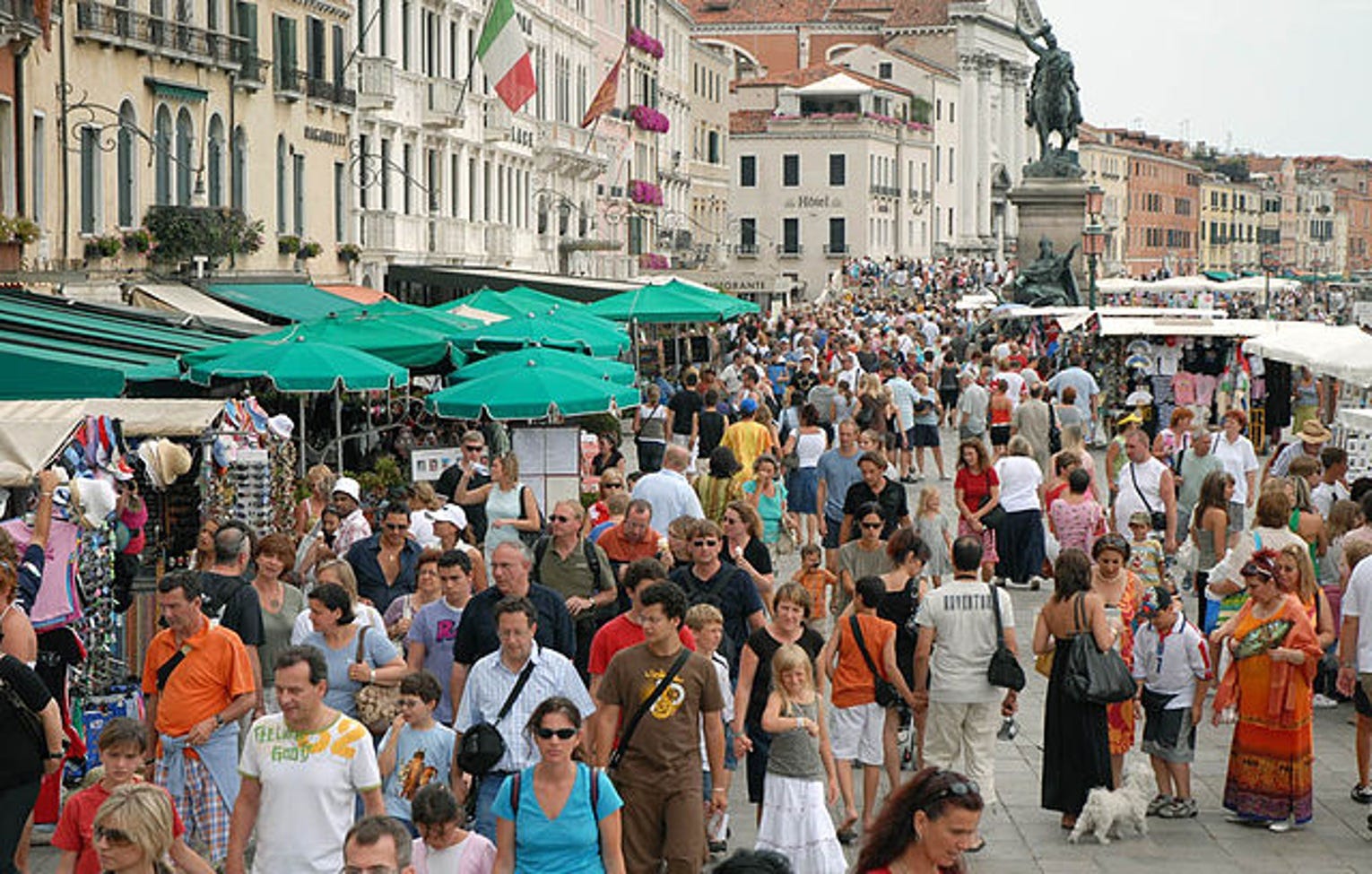
Modern Venetians have an interesting love/hate relationship with tourists. On the one hand, their city relies on them for its livelihood. (Let’s face it. The spice trade isn’t what it used to be.) On the other hand, there are just too many of them.
Venice’s population continues to decline. At present it stands at about 50,000 people — less than half its size in 1300. Venice can reasonably handle about 20,000 tourists per day before the streets and canals become clogged with traffic. A study by COSES, a research center funded by the Venetian government, found that more than 50,000 tourists descend on Venice each day. More recent estimates put daily tourist numbers at 80,000. And that is after cruise ships were banished from the city in 2020. Most of those tourists swoop in for the day, spending as little as possible in the expensive city. The recent (and poorly administered) Access Fee to capture income from day trippers has done nothing to dissuade the crowds, most of whom ignore the confusing system.
So, which of these dangers will destroy Venice?

Probably none. Venice’s challenges are real, yet as old as Venice itself. Waters have threatened the city since its foundation. As a struggle between man and nature, the Venetian lagoon has ever been a work in progress.
As for tourists, the people of Venice have welcomed every sort of traveler to their homes for more than a thousand years. They still do today for one very important reason: profit.
Newly elected Renaissance doges swore to promote the “honor and profit” of Venice. Modern Venice is still true to that promise. For all its difficulties, Venice remains a place of majestic beauty and vibrant commerce. It will overcome these most recent threats.
Or, as the Venetians are fond of saying about their city: “Sempre crolla, ma non cade.” It is always crumbling, but it never falls.
Thomas F. Madden is Professor of History at Saint Louis University and the author of Venice: A New History (Viking) and Enrico Dandolo and the Rise of Venice (Johns Hopkins).